Before You Go: How to Read Your Doctor’s Reviews Like a Patient, Not a Fan
Most people check restaurant reviews before they try a new place to eat. They’ll read six paragraphs about the pasta before committing to a Tuesday night out.
And then they’ll walk into a specialist’s office they’ve never been to, with a condition they’re scared about, having done exactly zero research on the person who’s about to tell them what’s wrong with them.

I understand why. We’re taught to trust the referral. Your doctor sent you there, so it must be fine. The office has diplomas on the wall. There’s a waiting room with magazines from 2019. It feels official.
But a referral is a suggestion, not a sentence. And diplomas don’t tell you whether the person who earned them still does the work.
Star Ratings Are Nearly Useless on Their Own
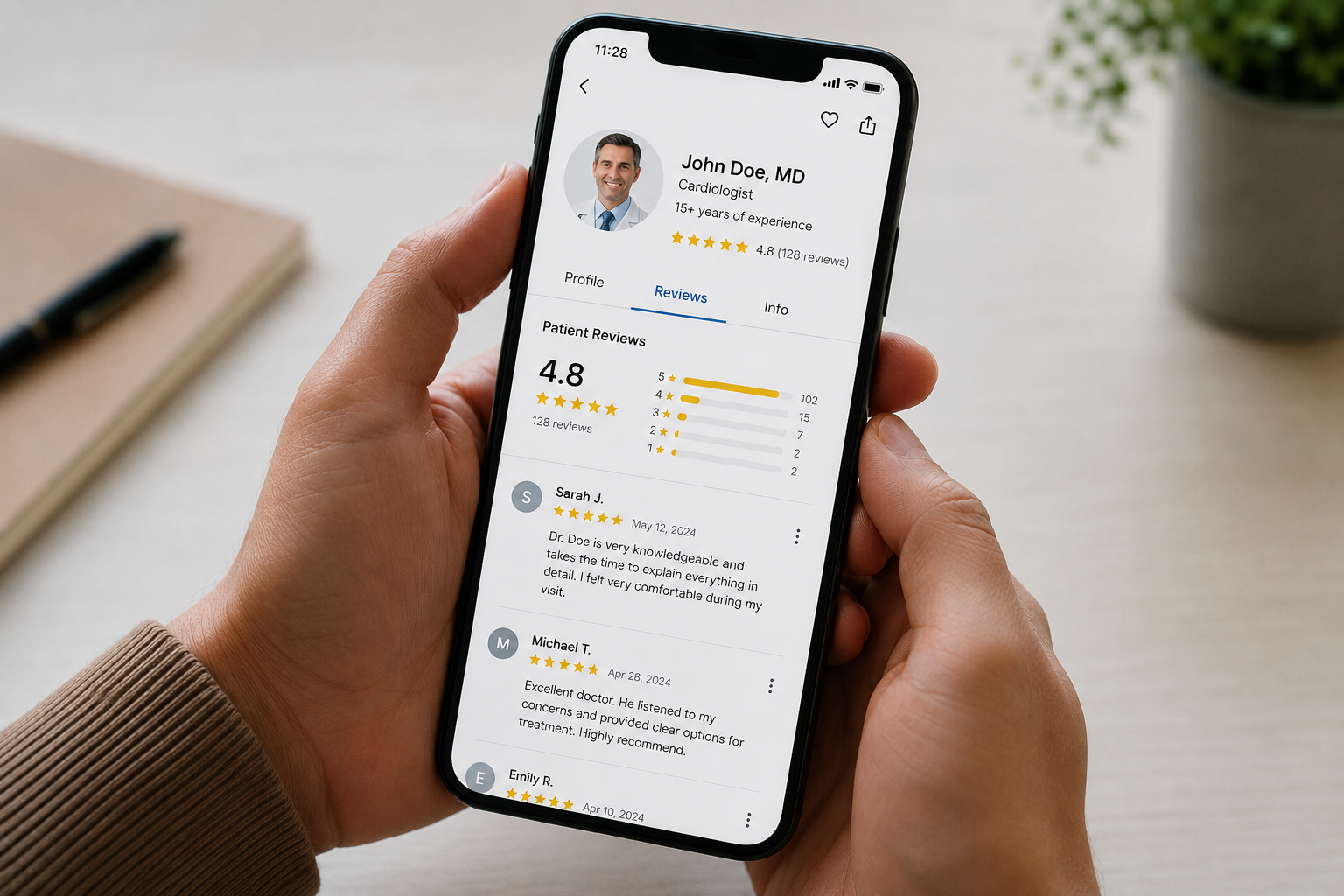
A 3.2 out of 5 tells you almost nothing. Neither does a 4.7. What matters is what’s inside the numbers — and most people never read past the stars.
Here’s the thing about doctor reviews specifically: the people who bother to leave them are usually either very satisfied or very not. Which means you’re working with a skewed sample by definition. Factor that in. A handful of glowing five-stars doesn’t mean every patient left happy. A few angry one-stars doesn’t always mean the doctor is bad — sometimes it means they had to deliver news someone didn’t want to hear.
What you’re looking for isn’t the rating. It’s the pattern.
Read for Repeated Language

This is the skill. This is the whole thing.
When the same words, phrases, or complaints appear across multiple unrelated reviews, you’re not reading opinions anymore. You’re reading data.
“Didn’t listen.” “Dismissed me.” “Blamed my weight.” “Rushed me out.” “Said the same thing to me that apparently she says to everyone.”
One person saying a doctor dismissed them could be a bad day, a personality clash, a miscommunication. Five people describing the same appointment — same language, same experience, same outcome — that’s a pattern. And a pattern is a policy.
Pay particular attention when reviewers describe specific things a provider said. Verbatim quotes in reviews are rare enough that when they appear, and when they match across reviewers, you’re looking at something that provider says habitually. A script. A routine. A way of ending appointments they’ve decided aren’t worth their time.
That’s not a red flag. That’s your stop sign and your warning to find another specialist.
What to Actually Look For
Magnifying glass resting on an open notebook filled with handwritten reviews and star ratings under a green desk lamp
When you’re reading reviews before a specialist appointment, filter for these:
Dismissal language. “Didn’t take me seriously,” “made me feel like I was faking,” “told me it was just stress/anxiety/weight.” One mention, note it. Three mentions, reconsider the appointment.
Bias patterns. Weight, age, gender, and race bias show up in reviews more than most people expect. Patients describe it because it was memorable and wrong. If multiple reviewers mention being told their symptoms were weight-related without further investigation, that’s clinical information.
What didn’t happen. Reviews often tell you what the provider didn’t do — didn’t review labs, didn’t explain the diagnosis, didn’t offer a follow-up plan. The absence of medicine is still information.
How complaints were handled. If there are responses from the practice to negative reviews, read those too. A defensive or dismissive response to a patient complaint tells you something about the culture of the office.
You Are Allowed to Find Your Own Specialist
If your instinct after reading reviews — or after a bad appointment — is to find someone else, trust it. Check what your insurance will cover, then do the work. Look for a specialist who has built a reputation for both skill and integrity. Someone whose negative reviews are about lesser things, like wait times, not about announcing they don’t believe in documented medical conditions.
A referral gets you in the door. It doesn’t obligate you to stay.
One More Thing
Reviews are a document. Like your lab results, like your discharge paperwork, like your MyChart notes — they contain information you are allowed to read, interpret, and act on.
You wouldn’t walk into surgery without knowing what procedure you were having. Don’t walk into a specialist’s office without knowing who you’re walking in to see.
The research takes twenty minutes. The wrong specialist can cost you months, your well-being, your lifestyle quality, or even your life.
Read Your Own Chart exists because too many of us have left appointments with more questions than answers and fewer answers than we deserved. You don’t need a medical degree to understand your own records — or to do your homework before you hand them over.