
She Didn’t Believe in Lupus
When my labs came back with lupus markers, I was sent to a rheumatologist who didn’t believe in lupus. This is what happened — why you should know and what you should know.

She Also Didn’t Believe in Looking at My Labs.
There’s a particular kind of medical appointment that stays with you. Not because it was traumatic, exactly — more because it was so breathtakingly weird that you spend the drive home wondering if you hallucinated it.
I’ve had a few of those.
It started with a PA at my doctor’s office who had that practiced, neutral expression healthcare providers wear when they’re pretty sure you’re wasting their time. You know the one. It’s professionally courteous in a way that somehow still communicates I see people like you every day.
She ordered bloodwork. Fine. But the way she framed it had a certain game-show energy to it:
If the results come back this way — fibromyalgia. You’ll see a neurologist.
If they come back the other way — lupus. You’ll see a rheumatologist.
Two doors. One prize. Let’s find out what’s wrong with you, or more accurately, let’s find out which specialist gets to tell you nothing is wrong with you.
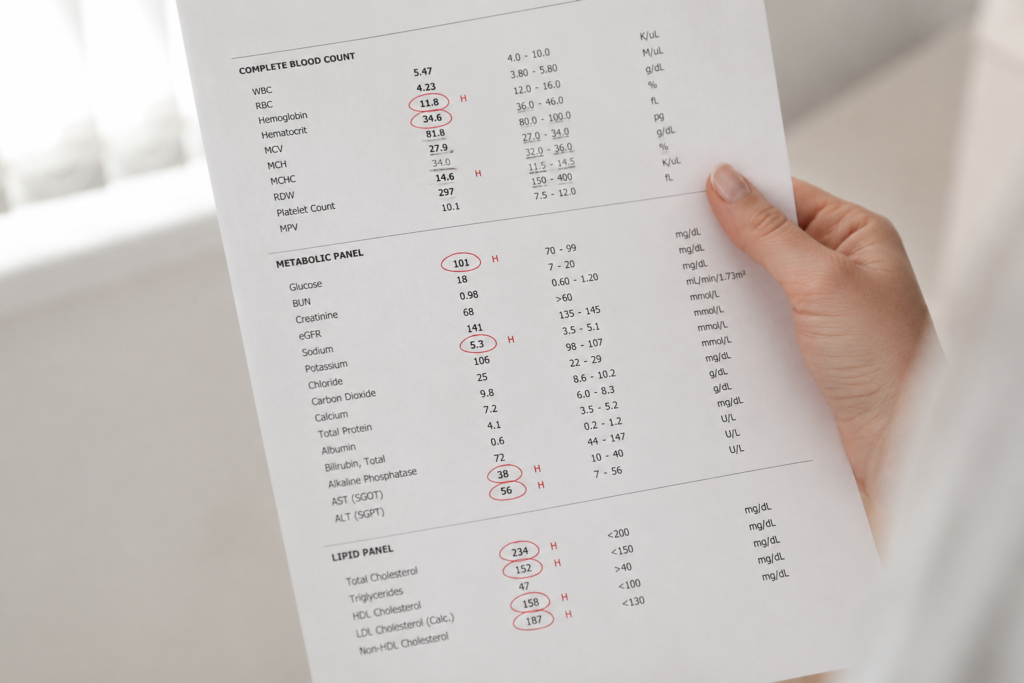
The results came back. Multiple markers. For lupus. Door number two.
So off I went to the rheumatologist.
I want to be fair here. I understand that Rheumatology is a genuinely complex specialty. Autoimmune conditions are notoriously difficult to diagnose, often presenting inconsistently, overlapping with each other, and requiring careful pattern recognition over time. Rheumatologists deal with a lot of uncertainty. I get it.
What I did not expect was a rheumatologist who had apparently resolved all that uncertainty by simply deciding not to believe in one of the most well-documented autoimmune diseases in existence.
She announced — and I want to be clear that announced is the right word, delivered with the confidence of someone unveiling a theorem — that she simply did not believe in lupus.
She then looked at my hair.
My hair, she explained, was too thick. Lupus causes hair loss. Therefore: not lupus.
I have many responses to this that I will keep to myself, but the headline is: a rheumatologist using hair thickness as a diagnostic tool is a choice.
Then came the weight commentary, delivered with equal confidence and a judgemental sneer. I was, in her professional assessment, too fat.
Now. I am not here to tell you I have the physique of an Olympic sprinter. I don’t. But “too fat” is not a differential diagnosis. It is not a treatment plan. It is not, in any sense of the word, medicine. It is a doctor deciding the visit is over before it started, and handing you back your chart with a bow on it.
Here’s what I actually walked out of that office with:
No follow-up plan. No explanation of my lab results. No discussion of what multiple lupus markers in my bloodwork actually meant, or didn’t mean, or needed further investigation to determine. Just the strong impression that I should eat less and be grateful she’d taken the time.
The labs existed. They were real. Someone ordered them, someone read them, and the results said what they said. A doctor choosing not to engage with them isn’t the same as the results being wrong.
What you should know if this sounds familiar:
Your lab results belong to you. You are entitled to a copy of everything — the actual numbers, the reference ranges, the flagged values. Not a summary. Not a portal notification that says “results reviewed.” The document.
A provider who dismisses your results without explaining why they’re dismissing them owes you an explanation you didn’t get.
“I don’t believe in this diagnosis” is not a clinical rationale. It’s what a lazy doctor says when they’ve stopped doing the work. Preferences don’t override data.
You are allowed to ask: “Can you walk me through why my results don’t concern you?” You are allowed to ask for a second opinion. You are allowed to request a referral to a different specialist. You are allowed to document the appointment in your own words as soon as you get to your car.
But know that a referral is a suggestion, not a sentence. You are allowed to find your own specialist. Check your insurance coverage, then do the work — look for someone who has built a reputation for both skill and integrity. For example, a rheumatologist who refuses to diagnose documented conditions based on personal bias isn’t a specialist. They’re an obstacle wearing a white coat.
And if a specialist tells you they don’t believe in a condition that the NIH, the CDC, the Lupus Foundation of America, and decades of peer-reviewed research have extensively documented — you are allowed to note, quietly, that their belief is not required for the condition to exist.
The labs came back. They said what they said. That’s not nothing, even though I felt I had been treated like a nothing.
Read Your Own Chart exists because too many of us have left appointments with more questions than answers and fewer answers than we deserved. You don’t need a medical degree to understand your own records. You just need someone to show you where to look.