
How to Turn a Government Health Notice Into a Conversation With Your Doctor
Most of us see a public health notice and feel a flicker of concern. Then we scroll past it. It’s easy to do. These alerts show up in our feeds all the time, and after a while they start to blend together.
But if you’re someone who advocates for your own health, or for someone you love, these notices are worth a second look. They’re not background noise. They’re information you can actually use.
Take a recent example. Crawford County Public Health posted a notice about a rise in diarrheal illness, likely tied to a parasite called Cyclospora. Our sister site, Galionite, covered the prevention side of this in detail: symptoms, what to watch for, and how to protect yourself in the kitchen. But there’s a second half to a notice like this one, and it’s the half most people skip: what you do with it if you or someone in your house actually gets sick.
Why These Notices Exist in the First Place
Every public health alert exists because someone, somewhere, is watching for patterns. That’s the whole job.
Local and county health departments are closest to the ground. They’re usually the first to notice when several people in the same area show up with the same unusual symptoms around the same time. That’s often how a notice like the Crawford County one gets started.
State health departments, like the Ohio Department of Health, track trends across counties. If something is showing up in more than one place, they’re the ones connecting those dots.
Federal agencies each have their own lane:
- The CDC tracks disease outbreaks and issues alerts through its Health Alert Network.
- The FDA handles drug and device safety through MedWatch, along with food and product recalls.
- The EPA tracks environmental exposures, including water quality issues, through public compliance records.
None of these agencies issue a notice for no reason. Something already happened enough times, or looked concerning enough, that someone decided it was worth telling the public.
Where to Find These, Ongoing
You don’t have to wait for one to land in your Facebook feed. A few places worth checking on your own:
- Your county health department’s Facebook page or newsletter
- The Ohio Department of Health’s alerts page
- The CDC’s Health Alert Network
- FDA MedWatch and recalls.gov
- EPA ECHO, if you ever want to look up compliance history for a local facility
Bookmark whichever ones apply to you. It takes five minutes and it means you’re not relying on an algorithm to decide whether you see something important.
Protecting Yourself Comes First

Prevention is always step one. If there’s a specific notice out there, like the Crawford County one, follow the practical steps: wash your hands, wash your produce, watch your water source if you have any doubt about it, stay hydrated, and stay home if you’re sick. We laid all of that out in detail on Galionite, so I won’t repeat it here.
But prevention isn’t the whole story. Sometimes you do everything right and still end up sick. That’s where the second half of this comes in.
The Part Most People Skip: Telling Your Doctor
Here’s what I mean by that. If you’ve had diarrhea for a week, that’s one piece of information. If you’ve had diarrhea for a week and you know your county issued a notice about a specific illness right around when it started, that’s a completely different piece of information. It gives your doctor a starting point instead of a guess.
Most people don’t make that connection out loud. They mention the symptoms and leave out the notice, either because they forgot, or because it felt like it might sound dramatic. It won’t. It’s context. Use it.
Here’s a simple way to bring it up:
“I saw that Crawford County Public Health posted a notice about a rise in diarrheal illness, possibly linked to a parasite called Cyclospora. I’ve had symptoms that match what they described, starting around [date]. I wanted to flag that in case it’s relevant to what you’re testing for.”
That’s it. You’re not diagnosing yourself. You’re handing your doctor a piece of information they might not have had otherwise, and letting them decide what to do with it.
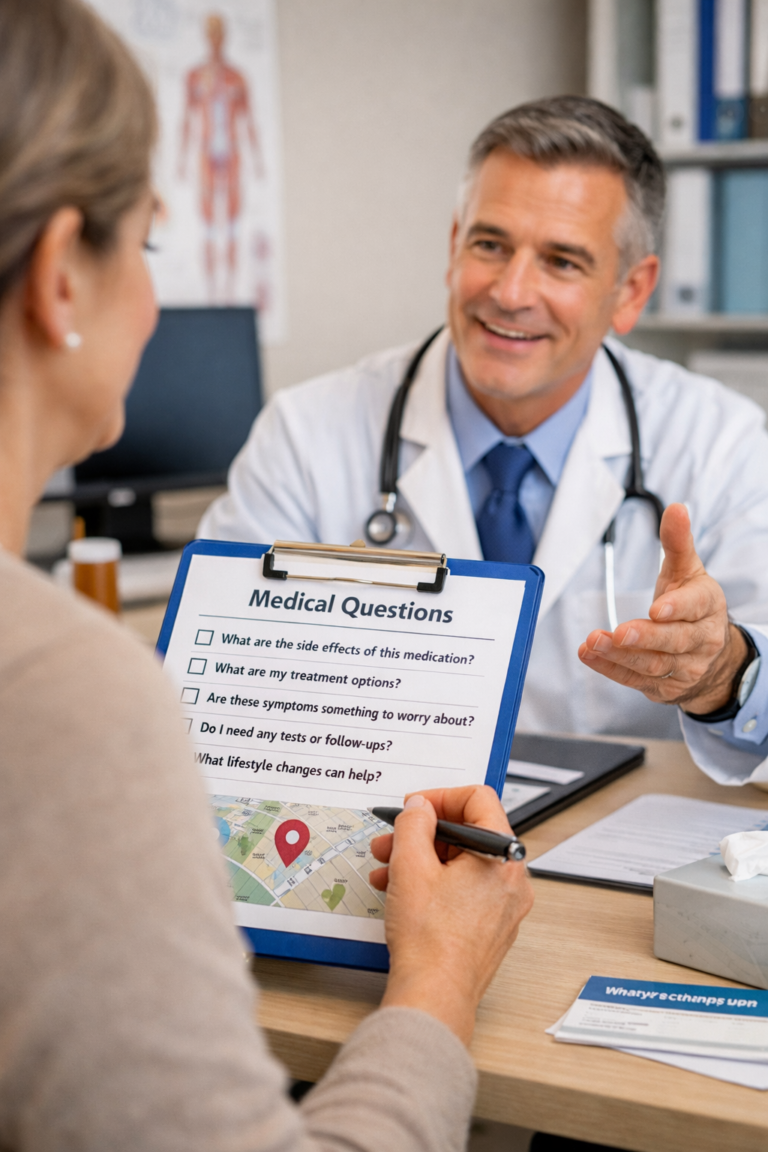
A few direct questions worth asking after that:
- “Is this something you’d test for specifically?”
- “Is this a reportable illness, and if so, does that change anything about what happens next?”
- “Can you document this exposure concern in my chart, even if we don’t run a test for it right now?”
That last question matters more than people realize.
Documenting It Yourself
I’ve spent a lot of time going through medical records, both my own and my son’s, and one thing I’ve learned is that saying something out loud in an appointment doesn’t guarantee it ends up in the chart. Sometimes it does. Sometimes it gets summarized down to nothing, or dropped entirely.
So don’t assume. Keep your own simple record:
- The date you saw the notice
- When your symptoms started
- What you told your provider, and when
- Whether they ordered testing, and what the result was
If you have access to a patient portal, this is a good use for it. After your appointment, you can often see the visit summary. If the exposure concern you mentioned isn’t in there, follow up. A short message like “I wanted to make sure my concern about possible Cyclospora exposure, which I mentioned during my visit on [date], is noted in my chart” takes two minutes and creates a written record either way.
If You Feel Dismissed
Sometimes a doctor will hear you out and decide testing isn’t necessary. That’s a reasonable medical judgment, and it happens for good reasons plenty of the time.
But even then, you can still ask that the concern itself be documented. “Patient reported concern about possible Cyclospora exposure following county health notice” is a very different chart note than nothing at all. It protects you if symptoms continue. It protects you if you seek a second opinion. And if it turns out you’re one of several people in your area dealing with the same thing, a documented pattern matters, even at the individual level.
You’re not trying to argue anyone into a diagnosis. You’re making sure the information you have doesn’t disappear the moment you leave the room.
The Bottom Line
Government health agencies do the surveillance. They watch for patterns, connect the dots across counties and states, and put the information out there. But the follow-through is on us. Reading the notice, protecting yourself, and then making sure that information actually reaches the person treating you, that’s what real self-advocacy looks like. Not distrust. Just making sure nothing gets lost between the alert and the exam room.
Related Reading
For the full prevention breakdown on the current Crawford County notice, including symptoms and specific steps to take in the kitchen, see our sister site Galionite’s coverage: Galionite: Crawford County Health Officials Warn of Rising Diarrheal Illness, Suspect Parasite
Sources
- Centers for Disease Control and Prevention, Health Alert Network
- Centers for Disease Control and Prevention, Cyclosporiasis
- U.S. Food and Drug Administration, MedWatch
- U.S. Food and Drug Administration, Recalls, Market Withdrawals, & Safety Alerts
- U.S. Environmental Protection Agency, ECHO (Enforcement and Compliance History Online)
- Ohio Department of Health, Public Health Alerts, odh.ohio.gov
- Crawford County Public Health, Facebook notice, June 2026