
Before You Say Yes to Ozempic: What to Research and Ask First
You have every right to understand what your body is being offered — before you agree to it.
If you’ve been to a doctor’s appointment lately and mentioned weight, there’s a decent chance GLP-1 medications came up. Ozempic. Wegovy. Mounjaro. Zepbound. These drugs are everywhere right now, and for some people they’re genuinely life-changing. For others, they’re not the right fit at all.
The problem isn’t the medications. The problem is that a lot of people are saying yes — or no — without really understanding what they’re agreeing to. And when it comes to your own health, “I’ll just trust my doctor on this one” is only a strategy if your doctor has the full picture and the time to walk you through it.
That’s where you come in.
This is not about being difficult or mistrustful. It’s about being an informed participant in your own care. There’s a difference between a patient who nods and a patient who asks questions, and the second kind tends to get better outcomes.
Start With the Basics: What Is GLP-1 and Why Does It Matter?
Before you can ask good questions, it helps to understand what you’re actually talking about.
GLP-1 stands for glucagon-like peptide-1. It’s a hormone your body already makes every time you eat. Its job is to signal your brain that you’re full, slow down digestion, and help regulate blood sugar by prompting your pancreas to release insulin. In short, it’s your body’s natural “I’m satisfied, you can stop now” signal.
GLP-1 medications work by mimicking that hormone and extending its effects. Normally, your body breaks down GLP-1 within a matter of minutes. These drugs keep that signal active for much longer, which is why they can be so effective at reducing appetite and supporting weight loss. The trade-off is that they’re powerful, they come with real side effects for some people, and they’re typically a long-term commitment.
Knowing this going in changes the conversation. You’re not just asking “will this help me lose weight.” You’re asking how this drug interacts with a system your body is already running on its own.
Do Your Research Before the Appointment
The best patient advocacy happens before you’re sitting in the exam room. When you walk in already knowing the basics, you stop being a passive recipient of information and start being a participant.
Here’s where to start:
- Know the drug names. Semaglutide is the active ingredient in both Ozempic and Wegovy. Tirzepatide is the ingredient in both Mounjaro and Zepbound. Ozempic and Mounjaro were originally approved for type 2 diabetes. Wegovy and Zepbound are the formulations approved specifically for weight loss. If your doctor recommends one of the diabetes versions for weight loss, that’s called off-label prescribing, and it’s legal and common — but worth knowing.
- Understand the eligibility criteria. FDA-approved GLP-1 drugs for weight loss are generally indicated for people with a BMI over 30, or a BMI over 27 with a weight-related health condition like high blood pressure, type 2 diabetes, or high cholesterol. Knowing where you fall helps you have a more grounded conversation about whether this is a clinical recommendation or more of a trend-driven one.
- Look up the common side effects. Nausea, vomiting, constipation, and diarrhea are the most frequently reported. Most are gastrointestinal and tend to be worse when starting or increasing the dose. There are also less common but more serious considerations including pancreatitis and, for people with a personal or family history of certain thyroid conditions, a contraindication worth knowing about. Going in informed means you can ask specifically about your situation rather than getting a general overview.
- Research what happens when you stop. This one is important and often skipped. Studies have shown that people who stop GLP-1 medications often regain a significant portion of the weight they lost. That’s not a reason to avoid the medication, but it is a reason to go in with clear eyes about whether this is a short-term tool or a longer commitment.
Reputable sources for your pre-appointment research include the FDA’s drug approval pages, Cleveland Clinic’s health library, and the National Institutes of Health. If something you read about GLP-1 conflicts with what your doctor says, that’s not a reason to dismiss either one. It’s a reason to ask a follow-up question.
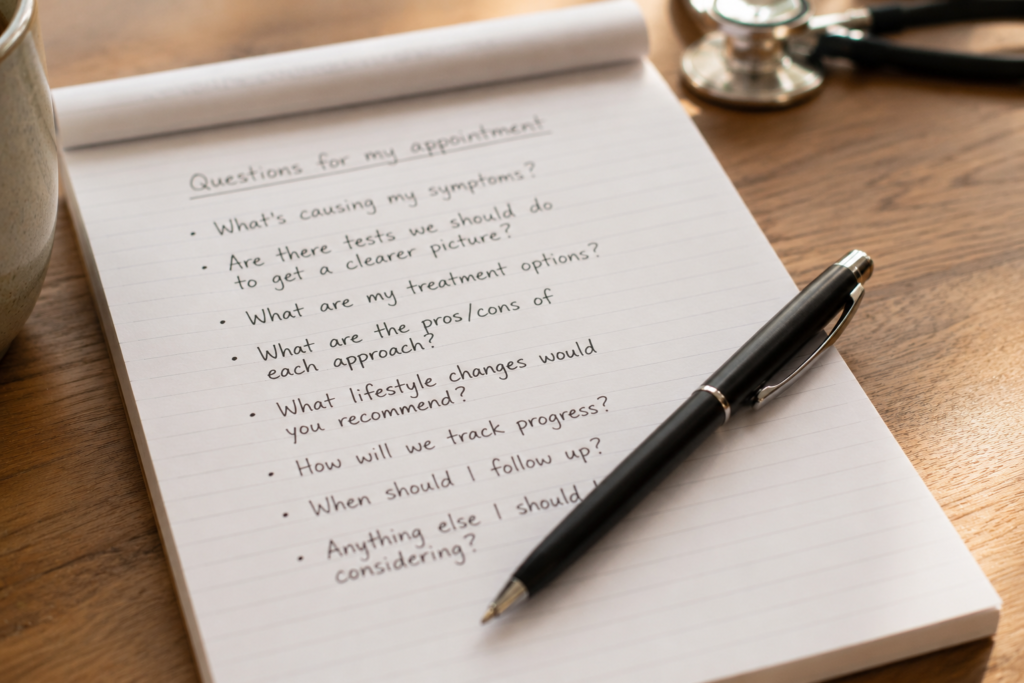
Questions to Bring to Your Appointment
Write these down. Bring the list. There is nothing awkward about having a piece of paper in your hand at a doctor’s appointment. It signals that you take your health seriously, and most good providers appreciate it.
About your candidacy:
- Based on my full health history, do you think I’m a good candidate for a GLP-1 medication?
- Are there any conditions I have or medications I’m taking that might interact with this?
- Is there a specific formulation you’re recommending, and why that one over the others?
About the medication itself:
- What does starting the dose look like, and how will we know if it’s working?
- What side effects should I watch for, and what would prompt you to adjust or stop the medication?
- Is this something I’d take indefinitely, or is there an expected endpoint?
About your options:
- What do you recommend alongside the medication in terms of diet or lifestyle changes?
- Are there things I could try first, or in combination, before committing to a prescription?
- What does the research say about long-term outcomes for people in my situation?
About the practical side:
- Is this covered by my insurance, and if not, what does it cost?
- What happens if I need to stop due to side effects or cost?
You don’t have to ask all of these. Pick the ones that matter most to your situation. But having them ready means you leave the appointment with real information instead of a prescription and a vague sense that things are probably fine.
What About Natural GLP-1 Support?
Worth mentioning, because it’s relevant and because it might be part of your conversation with your provider.
Your body already produces GLP-1 in response to what you eat. Certain foods — eggs, fish, lentils, oats, avocado, olive oil, raspberries — support that natural release. Eating protein and fiber before carbohydrates at a meal, slowing down while you eat, and building meals around whole foods are all things that research suggests can support your body’s own GLP-1 response.
This isn’t a replacement for medication when medication is genuinely indicated. But it’s worth knowing because it gives you something concrete to do while you’re researching, and because it’s the kind of information that helps you show up to the conversation with your provider as someone who’s already engaged with their own health.
For a deeper look at the foods that support natural GLP-1 release and what that means for satiety, weight loss, and joint health, the Intrinsic Vicissitude wellness post on this topic is a solid read. [link to IV article]
The Bottom Line
GLP-1 medications may be a genuinely good option for you. They may not be. The point isn’t to talk you in or out of anything. The point is that you deserve to make that decision with enough information to actually make it.
Your doctor has expertise you don’t have. You have context about your own body, your history, your life, and your priorities that your doctor can only know if you share it. The appointment works best when both things are in the room.
Research before you go. Write down your questions. Ask them out loud. If an answer doesn’t make sense, say so. That’s not being difficult. That’s being a patient who’s paying attention.
And that’s exactly the kind of patient who gets better care.
Sources
- U.S. News and World Report: 13 Questions to Ask Your Doctor Before Starting a GLP-1 Weight Loss Drug
- Cleveland Clinic: Answering Your Questions About GLP-1s
- Mochi Health: What Providers Wish Patients Knew Before Starting GLP-1s
This post contains an affiliate link for a top-notch GLP-1 diet book. If you buy something through a link here, I may earn a small commission — no extra cost to you. I only link to things worth your time.